
Techtonix Engine
Tectonix Engine
Physics Driven Earthquake Simulation Platform for Bangladesh
Tectonix Engine is a full stack seismic simulation system designed to model earthquake ground motion on the tectonic framework of Bangladesh using physically motivated formulations rather than heuristic visualizations.
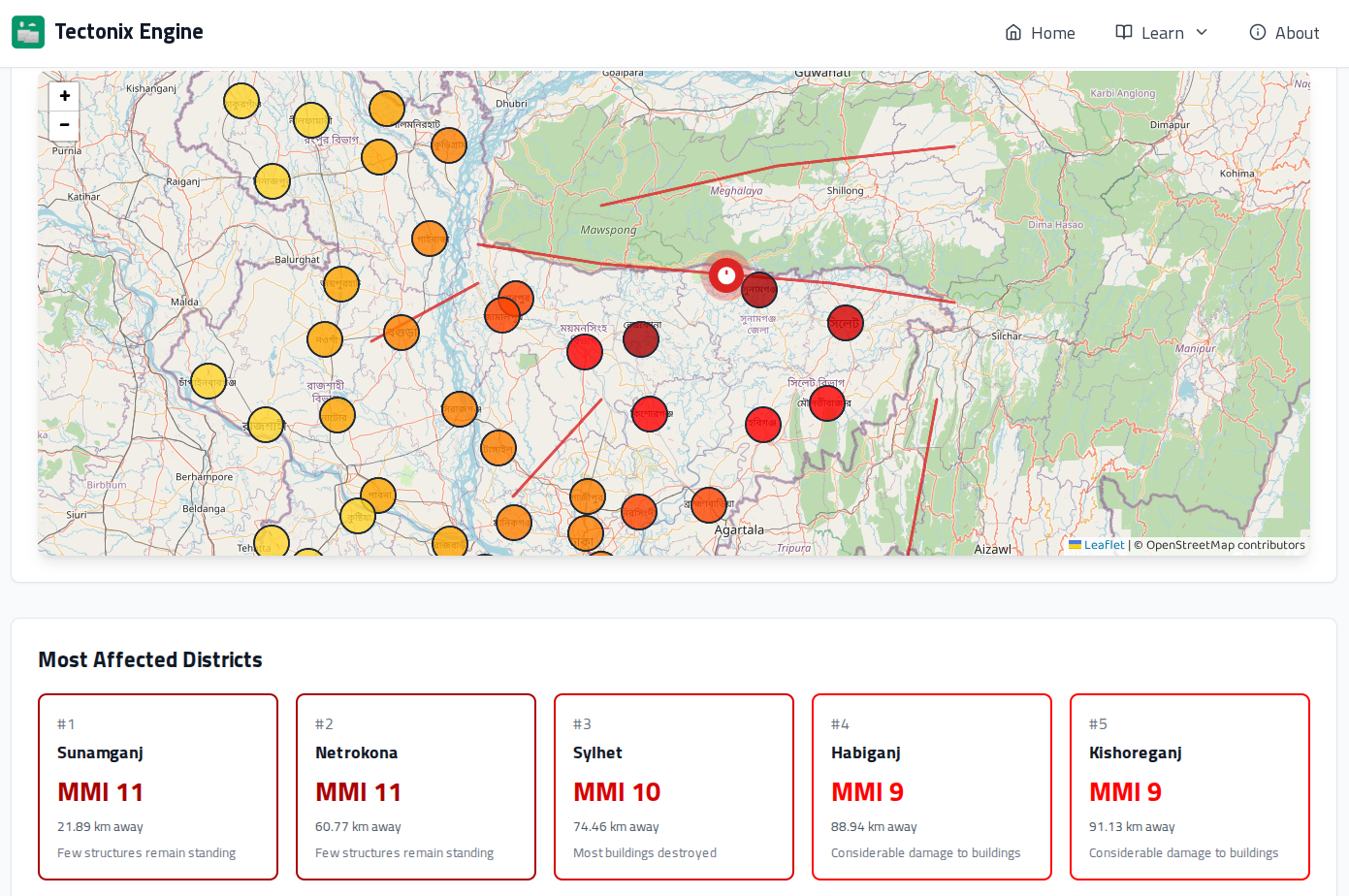
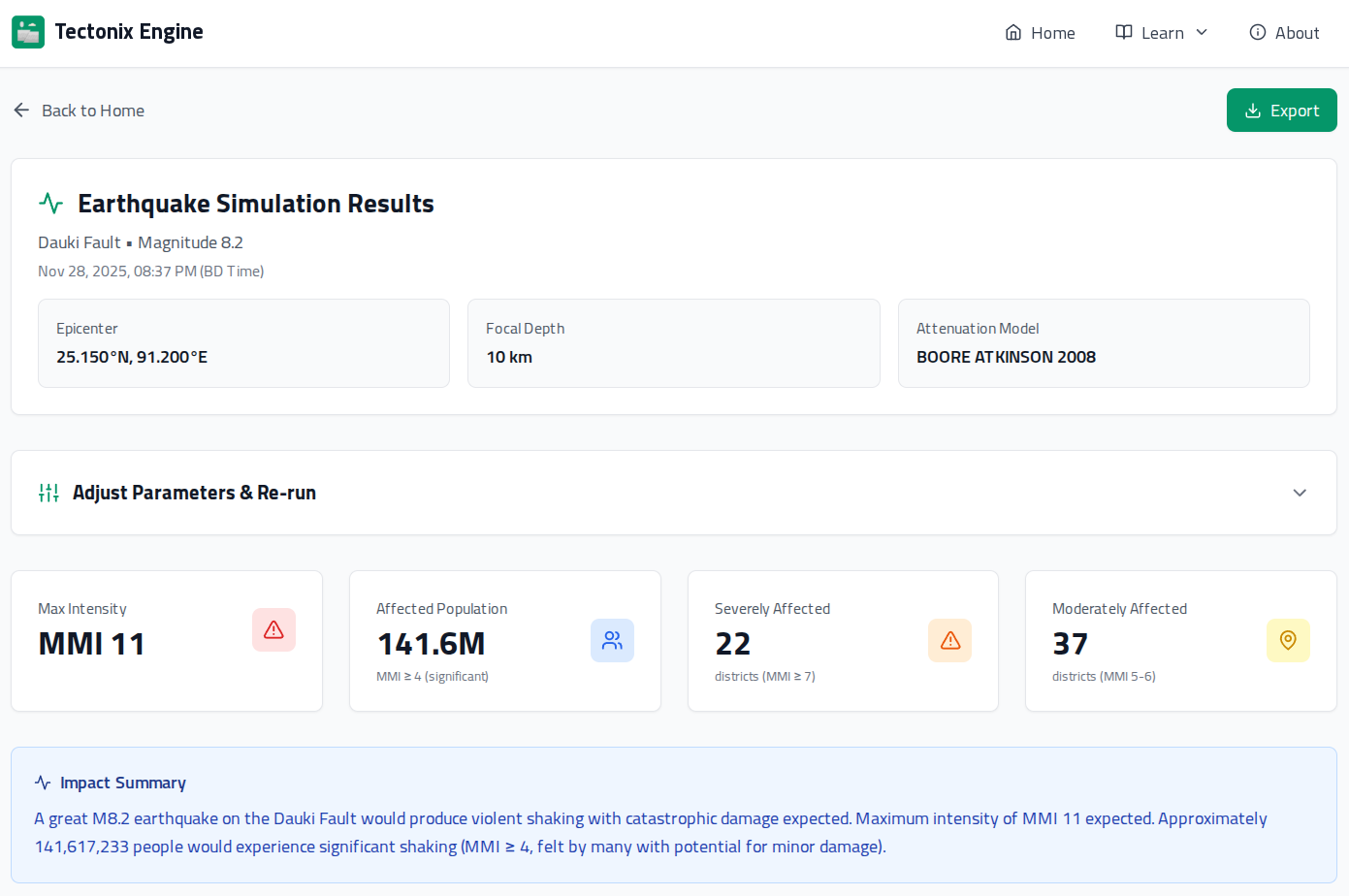
The system integrates fault geometry, regional seismotectonics, soil response, and attenuation theory to estimate Peak Ground Acceleration PGA and Modified Mercalli Intensity MMI at the district level. The emphasis of the project is correctness of physical behavior, numerical stability, and transparency of assumptions.
Core Objective
To provide a reproducible and extensible earthquake scenario simulator that bridges academic seismology models and interactive visualization, with a specific focus on Bangladesh’s shallow crust, soft soil conditions, and high population density.
Modeling Approach
Earthquake ground motion is computed using a custom Ground Motion Prediction Equation of the form
Where,
- M is moment magnitude
- R_hyp is hypocentral distance
- h(M) is a magnitude dependent pseudo depth term
- Vs30 is the time averaged shear wave velocity in the top 30 meters
This formulation avoids unrealistic near field saturation for large magnitudes and captures spatial amplification caused by soft alluvial soils common across Bangladesh.
Site Amplification
Instead of discrete soil classes, the simulator uses continuous Vs30 based site response
pythonf_site = A_site * log10(Vs30 / 760)
This allows physically consistent amplification where lower Vs30 values produce higher ground motion, aligning with NEHRP and modern seismic hazard standards.
Intensity Conversion
MMI is derived from PGA using a continuous logarithmic relationship,
This replaces traditional piecewise mappings and eliminates discontinuities in the critical MMI 4 to 6 range. Optional aleatory variability is included for probabilistic extensions.
Simulation Modes
- Realistic mode: Magnitude is derived from fault length and stress characteristics
- Hypothetical mode: User defined magnitude constrained by fault specific maximum credible limits
Visualization and Output
- Interactive map based visualization of fault lines, epicenters, and district wise intensity
- Real time computation of PGA, MMI, distance, and impact metrics
- Exportable results in JSON, CSV, and structured text formats
Technology Stack
- Backend implemented in PyPlain using scientific Python libraries for numerical stability
- Frontend built with Next.js (HolyNext), TypeScript, and Leaflet for geospatial interaction
- Supports MongoDB or PostgreSQL for simulation history and metadata
- Designed for local execution and production deployment without container dependency
Research Orientation
The architecture preserves compatibility with established GMPE models such as Boore Atkinson 2008 and Joyner Boore 1997 while enabling regional calibration. All parameters are explicitly defined and tunable, making the system suitable for academic experimentation, scenario analysis, and future probabilistic seismic hazard assessment.
This project reflects an engineering first interpretation of seismology where equations, assumptions, and limits are visible rather than abstracted.
In short, Tectonix Engine treats earthquakes as physics problems before they become maps.
https://tectonix.rajieb.dev/